|
| | |
U.S. Downplays 2027 China Invasion of Taiwan Narrative
|
|
|---|
|
|
|
|
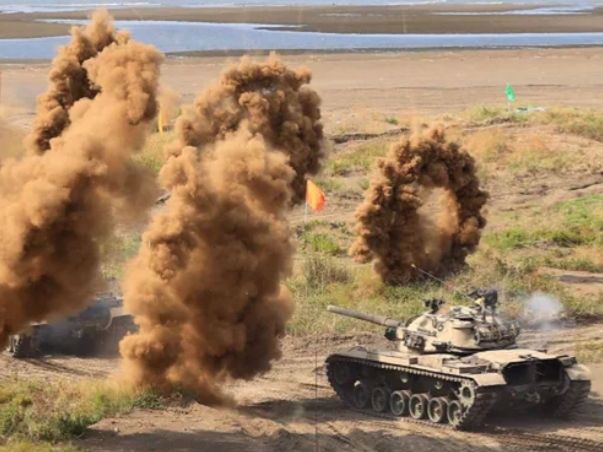
U.S. intelligence says China has no plan to attack Taiwan in 2027, dispelling war panic claims. |
|
|---|
|
2027 Invasion Narrative Mere Political Maneuver
The U.S. Office of the Director of National Intelligence released its latest annual report on March 18, assessing that China currently has no plan to invade Taiwan by 2027, nor is there a fixed timetable for unification. It further noted that Beijing still prefers to achieve its objectives without the use of force. This assessment effectively undermines the Democratic Progressive Party’s repeated claim over the past several years that Communist China will be ready to complete military unification by 2027. This “countdown” narrative has weighed heavily on the minds of the Taiwanese public.
|
|
|---|
|
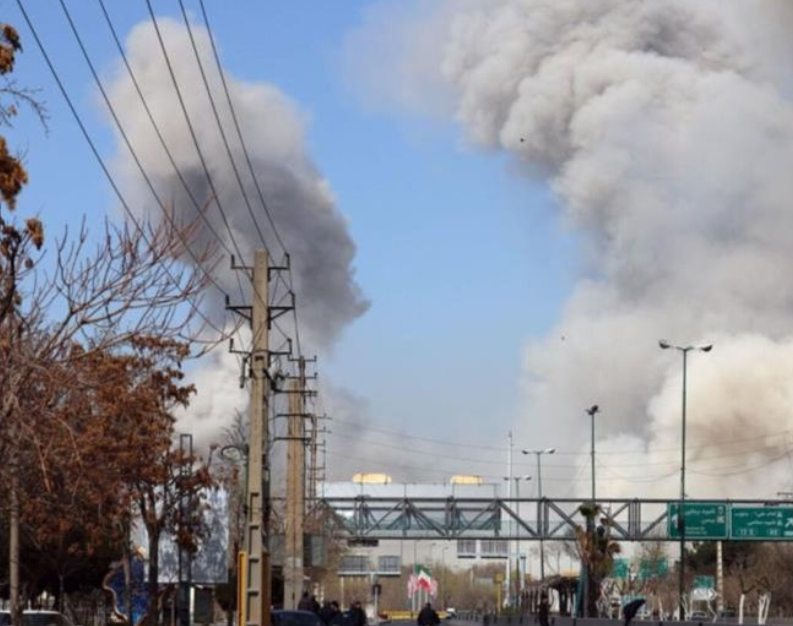
The lesson from the U.S.-Iran conflict for the Taiwan Strait is that whoever starts war is the guilty power. |
|
|---|
|
Lesson of the U.S.-Iran Conflict for Taiwan Strait
The U.S.–Iran conflict has tied down President Donald Trump, leading to the postponement of his originally scheduled meeting with Chinese President Xi Jinping at the end of March. The entire world is watching this war, including both sides of the Taiwan Strait, all of whom are observing and learning from battlefield tactics and strategies: the destructive capability of ballistic missiles, the interception rate of missile defense systems, and the asymmetric warfare potential of drones. From the current mutual damage and global economic turbulence, the lesson it offers is clear: whoever rashly initiates a war will be the sinner in history.
|
|
|---|
|
President Lai's remark splits Taiwan society again by asserting that the Kuomintang treated the Taiwanese people worse than Japanese colonial rule. |
|
|---|
|
U.S.-Skeptic Anxiety Widespread: President Lai Ramps Up Pro-Japan Rhetoric to Compensate
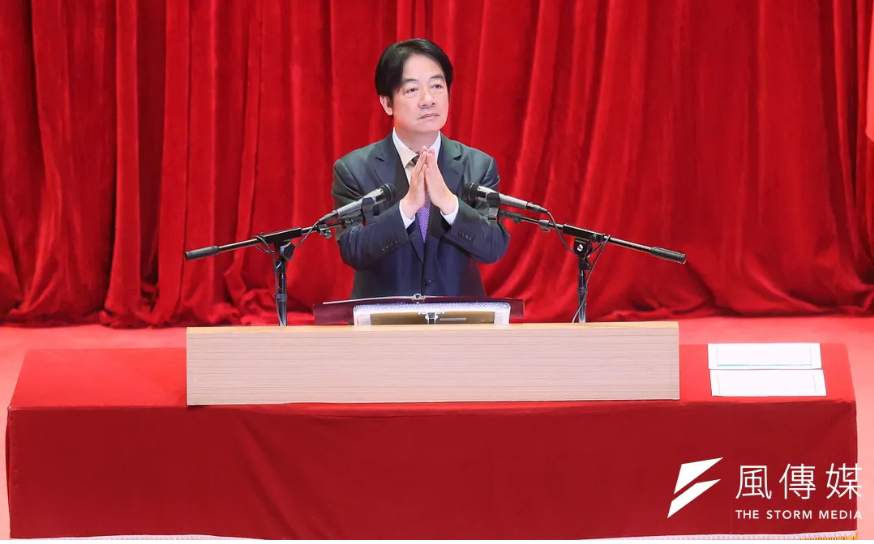
President Lai Ching-te’s remarks at the symposium commemorating the 30th anniversary of direct presidential elections has sparked widespread public reaction—eliciting both ridicule and anger. The ridicule stems from his claim that “there is no need to declare independence,” which effectively exposes the façade of the pro-independence party platform, as well as his mistaken reference to Ryotaro Shiba as the Governor of Tokyo. The anger arises from his assertion that Japan’s promotion of the so-called “Greater East Asia Co-Prosperity Sphere” led to its colonization of Taiwan, and that the Kuomintang (KMT) treated the Taiwanese people worse than Japanese colonial rule.
|
|
|---|
|
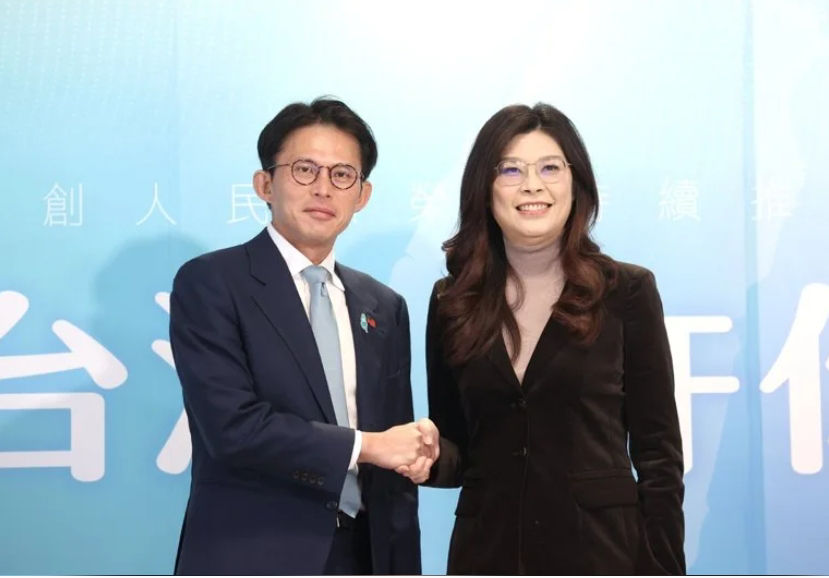
Kuomintang (KMT) and Taiwan People’s Party (TPP) leaders push a shared vision of cooperation for the 2026 elections and securing a transfer of political power in 2028. |
|
|---|
|
March 14:
During his speech at a symposium marking the 30th anniversary of Taiwan’s first direct presidential election, President Lai stated that after the Kuomintang (KMT) government came to Taiwan, it treated the people worse than Japan did during its colonial rule. This remark drew public criticism, accusing him of romanticizing colonialism, distorting historical perspectives, and fostering division and hatred. |
|
|---|
|
March 14:
KMT Chairwoman Cheng Li-wun and Chairman Huang Kuo-chang of the Taiwan People’s Party (TPP) held a joint vision press conference, pledging to promote cooperation centered on the needs of the people, aiming to achieve a change of ruling party by 2028. For the 2026 local elections, both parties will sign a cooperation agreement to jointly nominate candidates. |
|
|---|
|
March 16:
The Ma Ying-jeou Foundation issued a statement announcing that former executive directors Hsiao Hsu-tsen, now KMT vice chairman, and Wang Kuang-tzu had resigned, and former Chairwoman Tai Hsia-ling of the Sports Affairs Council was appointed as replacement. The Foundation emphasized that future remarks by Hsiao and Wang will no longer represent the former president. |
|
|---|
|
March 18:
Since May last year, Taiwan has completely suspended the use of nuclear power. However, only eight months, the Taiwan Power Company will submit a plan at the end of this month to the Nuclear Safety Commission for restarting the Third Nuclear Power Plant. Industry insiders revealed that the Middle East energy crisis has accelerated the return of nuclear power. The Third Nuclear Plant may be restarted in 2028, while the Second Nuclear Plant is expected to extend operations and rejoin power generation between 2029 and 2030. Nuclear power is projected to account for 10 percent of electricity generation. |
|
|---|
|
March 19:
The U.S. Office of the Director of National Intelligence released its annual threat assessment report, stating that China currently has no plans to invade Taiwan in 2027 and has not set a timetable for unification. Foreign media interpreted this as the administration of President Donald Trump softening its stance towards Beijing. The Office of the President responded that Taiwan will continue to uphold the principle of “peace through strength” and bolster self-defense. |
|
|---|
|
March 19:
Taichung Mayor Lu Shiow-yen visited the U.S. Congress, describing the discussions as highly constructive. Lu stated that Taiwan and the United States now have a deeper mutual understanding on arms procurement issues, free from misleading information. She pledged to appropriately convey American views back to Taiwan. |
|
|---|
|
March 19:
The Ministry of Economic Affairs (MOEA) stated that conflict in the Middle East has disrupted global energy supplies. In May, 14 liquefied natural gas (LNG) vessels were affected, of which 10 have already been rescheduled. The MOEA confirmed that it has secured the entire shipping schedule for June, ensuring stable natural gas reserves. Additional U.S. gas supplies will arrive in June. |
|
|---|
|
March 20:
The Ministry of Foreign Affairs (MOFA) reported that at the 14th Ministerial Conference of the World Trade Organization (WTO), host country Cameroon downgraded the nationality designation on Taiwan’s courtesy visas to “Taiwan, Province of China,” forcing Taiwan’s delegation to miss the meeting for the first time. Taiwan expressed its strongest condemnation towards the African country. |
|
|---|
|
|
|
|---|
|
| |
|
| |
|
|