A small renovation company from Tainan won a NT$1.5 billion (about US$45 million) arms procurement bid, sparking controversy. Legislators question rule-breaking purchases and potential corruption. |
|
|---|
|
Lai Administration Undermines Public Trust in National Defense Budget
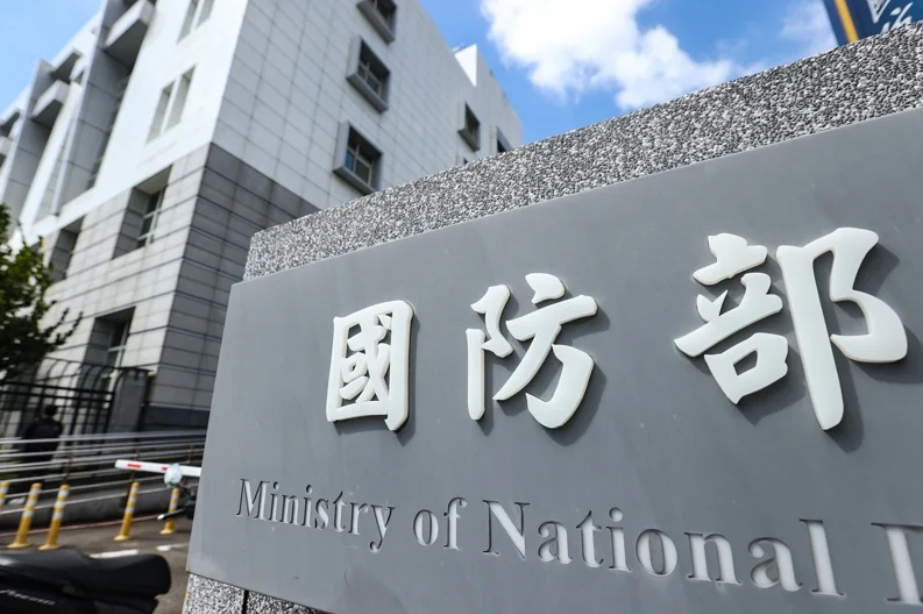
Whether to align with the United States or to strengthen Taiwan’s defense against China, President Lai Ching-te revealed in an interview with foreign media that Taiwan plans to allocate NT$1.25 trillion (about US$39.8 billion) in a special national defense budget. The special bill, however, was blocked for the second time by opposition parties during the Legislative Yuan’s Procedure Committee review on December 9. The next day, Lai urged the opposition to unite against external threats and allow the budget to proceed to committee review. Yet even before the words faded, a small interior renovation company in Tainan not only won a Ministry of National Defense (MND) NT$590 million (about US$18.8 million) tender for RDX explosives, but lawmakers further revealed that it is lined up for an additional nearly NT$900 million (about US$28.6 million) open-ended contract—amounting to roughly NT$1.5 billion (about US$47.8 million) in total business.
|
|
|---|
|
The Pentagon reveals that U.S. forces may be unable to defend Taiwan in time. The American Institute in Taiwan (AIT) still urges Taiwan to increase arms purchases, while the NT$1.25 trillion (about US$37.5 billion) defense budget remains deadlocked. |
|
|---|
|
Can the U.S. Defend Taiwan? Pentagon and AIT Views Diverge
The administration of President Lai Ching-te has proposed an eight-year NT$1.25 trillion (about US$39.8 billion) special national defense budget. The opposition demanded that the president report to the Legislative Yuan but were unsuccessful, preventing the bill from being placed on the agenda for review. Director Raymond Greene of the American Institute in Taiwan (AIT) took a strong stance, “explaining the greater good” to the Taiwanese public: in response to criticisms of “increasing Taiwan’s defense spending,” he warned that such views are unlikely to gain international support. He added that if Taiwan does not invest in its own defense, it would be “extremely difficult” for the United States to provide defensive weapons under the Taiwan Relations Act.
|
|
|---|
|
The Ministry of the Interior suddenly banned Xiaohongshu (RedNote), citing combatting fraud as the pretext but raising suspicions of abuse of power. Selective enforcement has attracted concerns over free speech. |
|
|---|
|
Real Reason Behind Government's Ban on RedNote
The Democratic Progressive Party (DPP) administration, whose performance and resolve in combating fraud are hardly commendable, suddenly banned the mainland Chinese social media platform Xiaohongshu (RedNote) last week in the name of anti-fraud. Over the past two years, RedNote has had more than 1,700 fraud cases—a tiny number compared to Facebook’s 50,000.
|
|
|---|
|
The Asian Development Bank (ADB) raises Taiwan’s economic growth forecast to 7.3 percent, but severe wealth inequality persists. |
|
|---|
|
December 5:
The administration of President Lai Ching-te announced a one-year ban on the mainland Chinese social media and e-commerce platform Xiaohongshu (RedNote). Premier Cho Jung-tai stated that if RedNote fails to improve in the future, then the government may consider “cutting it off completely.” He also singled out TikTok, noting that although it has responded to Taiwan’s requests, continued lack of improvement will not be tolerated. |
|
|---|
|
December 6:
The White House released the latest National Security Strategy, which drew divergent interpretations. Lee Hsiang-chou, former director-general of the National Security Bureau, indicated that the United States traditionally uses the term “oppose” regarding any unilateral change to the status quo in the Taiwan Strait, but this time the wording was changed to “does not support,” weakening the American commitment to Taiwan. The New York Times revealed a classified Pentagon “overmatch Brief,” warning that in multiple war-game simulations of new forms of warfare, the United States repeatedly lost, raising concerns that the U.S. may be unable to defend Taiwan. |
|
|---|
|
December 6::
Mainland China conducted its first maritime search-and-rescue emergency drill in Taiwan’s shallow waters. The exercise covered areas including Taiwan’s shallows, the central Taiwan Strait, busy shipping lanes, and accident-prone zones. The mainland’s Ministry of Foreign Affairs stated that the activities were strictly in accordance with domestic and international law in the relevant waters and should not be over-interpreted. |
|
|---|
|
December 7:
The U.S. Senate and House of Representatives released a consensus version of the annual National Defense Authorization Act, which authorizes up to $1 billion in military aid to Taiwan. The act includes U.S.-Taiwan cooperation projects on coast guard and drones but removed language inviting Taiwan to participate in the RIMPAC military exercises. |
|
|---|
|
December 8:
South Korea has continued to list Taiwan as “China (Taiwan)” on its electronic entry declaration forms since February without correction. The Ministry of Foreign Affairs announced a comprehensive review of relations with the South Korean government, considering countermeasures, and highlighted the issue of Taiwan’s trade deficit with South Korea. |
|
|---|
|
December 10:
The Executive Yuan approved draft amendments to the Artificial Reproduction Act, expanding eligibility to include female same-sex spouses and single women over 18. The more controversial issue of surrogacy was definitively excluded, and male same-sex couples were not included due to lack of consensus. |
|
|---|
|
December 10:
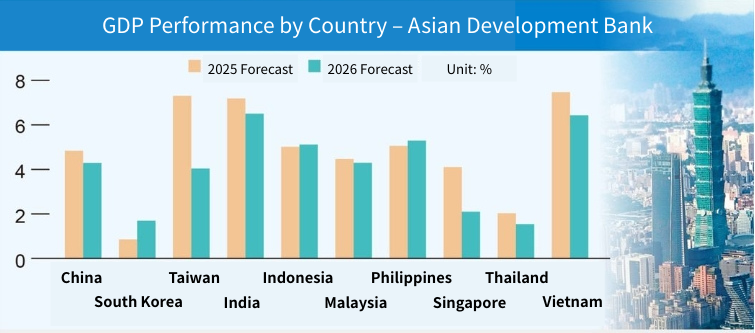
Driven by AI-related business opportunities, Taiwan’s exports in November reached $64 billion, the highest single-month record in history. Exports to the United States accounted for 38.1 percent, firmly making it Taiwan’s largest export market. The divergent trend of “strong technology, weak traditional industries” has not eased. The Asian Development Bank raised Taiwan’s economic growth forecast to 7.3 percent, second only to Vietnam in the Asia-Pacific region. However, the World Inequality Report 2026 noted that the top 10 percent of Taiwan’s income earners receive 48 percent of total income, while the bottom 50 percent account for only 12 percent, reflecting severe income inequality. |
|
|---|
|
December 11:
The Ministry of National Defense (MND) awarded the “RDX Sea Sweeper” explosives procurement contract to an interior design company. The winning bid was NT$5.9 billion (about US$18.9 million), with additional follow-up contracts bringing the total scale to over NT$14 billion (about US$45.2 million). Opposition parties questioned whether the MND deliberately set no entry thresholds, calling it a textbook case of bid-rigging and tied bidding. |
|
|---|
|
|